News & Events
Philanthropy and the Public Good
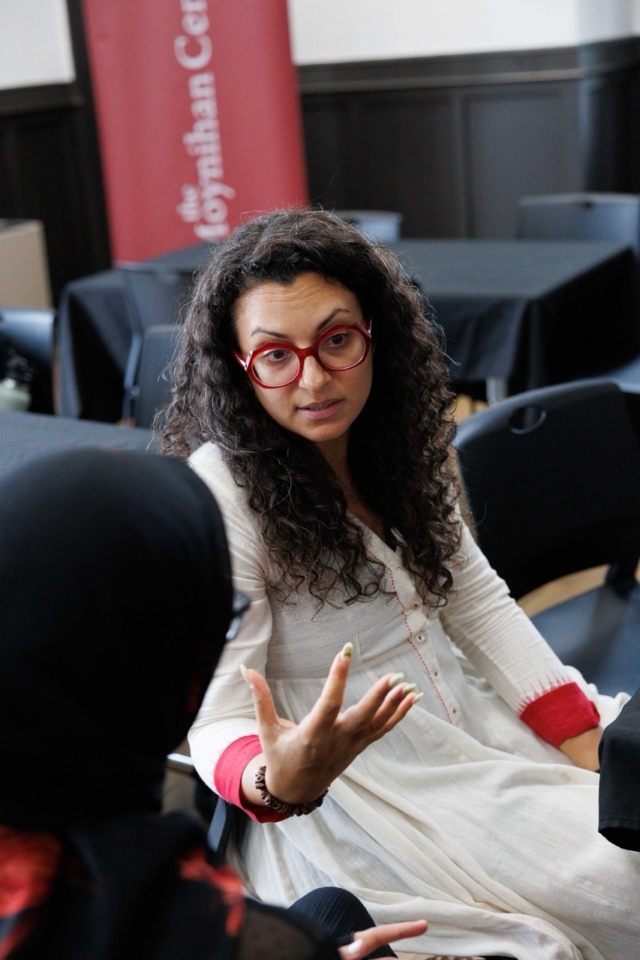
This fall, the Moynihan Center is delighted to welcome Danielle Goonan as an adjunct lecturer in CCNY’s Department of Political Science, where she is teaching Philanthropy and the Public Good—one of four required courses for Moynihan Public Service Fellows.
A social impact executive with nearly two decades of experience across the nonprofit, government, and private sectors, Goonan brings extensive experience in philanthropy, workforce development, and cross-sector partnerships to the classroom. At Walmart, she led the employer practice change, place-based, and tech-for-good components of a $100 million global workforce and education portfolio and helped design the Live Better U higher education benefit for 1.2 million employees. As a Schedule C political appointee in the Obama administration, she led strategic partnerships for the U.S. Department of Education and helped secure more than 100 private-sector commitments for the UpSkill America initiative. At the Clinton Global Initiative, she mobilized more than $550 million in Commitments to Action focused on workforce development and youth employment. She currently works at a private foundation.
For Goonan, who was raised in Brooklyn in a working-class family, the appointment also represents a homecoming. CUNY has been a fixture in her life since childhood—from dance recitals and school graduations at Brooklyn College to her introduction to college access as a teenager through Kingsborough Community College's College Now program. Teaching, she has said, is something she has wanted to pursue for a long time.
The course centers on a question that is open-ended and genuinely contested: Is philanthropy in the interest of the public good? Students trace the historical development of philanthropy, from ancient Greece and religious tithing traditions to the rise of the American foundation model, while also examining the contemporary landscape of private foundations, community foundations, donor-advised funds, corporate foundations, and LLCs.
Two themes anchor the inquiry: the good life—what human flourishing requires and who gets to define it—and pluralism, including whether philanthropy strengthens or distorts the diversity of voices in democratic life.
Through case studies, structured debates, simulations, and conversations with senior philanthropic leaders, including Keesha Gaskins-Nathan of the Rockefeller Brothers Fund, Sharnita Johnson of the Victoria Foundation, and Amy Freitag, formerly of the New York Community Trust, fellows build the analytical tools, historical knowledge, and field exposure to develop their own informed arguments about philanthropy's potential and its limits.
“I am beyond excited to spend a semester with whip-smart working-class kids who are hungry for a chance to prove themselves and have an impact. I take seriously the responsibility to impart something useful that they can use whether in their academic, professional or personal lives…because, well, I was, and in so many ways still am, them,” Goonan said.
Why this course matters:
Philanthropy plays a central role in determining how public goods are funded and whose voices get amplified in American civic life, while operating with far less of the democratic accountability expected of government. For Moynihan Fellows preparing to work across nonprofit, government, and private institutions, that tension is not abstract. It is the terrain they will navigate. Asking students to hold two things at once—an appreciation for what philanthropy has enabled and a clear-eyed examination of its limits—reflects exactly the kind of open, cross-partisan inquiry the Center was created to foster.